
If you recently lost your job, had your hours reduced, or are no longer working, you may be wondering whether you qualify for Connecticut unemployment benefits.
Connecticut unemployment eligibility depends on several factors. The Connecticut Department of Labor (CTDOL) generally looks at your wages and employment history, why you are no longer working, whether you are able and available to work, and whether you are meeting ongoing requirements such as searching for work.
Being unemployed does not automatically mean that you will receive benefits. CTDOL reviews each claim and may conduct a fact-finding process when additional information is needed.
This guide explains the main Connecticut unemployment eligibility requirements, what can affect your claim, and what you should know before filing through ReEmployCT.
What Are the Basic Connecticut Unemployment Eligibility Requirements?
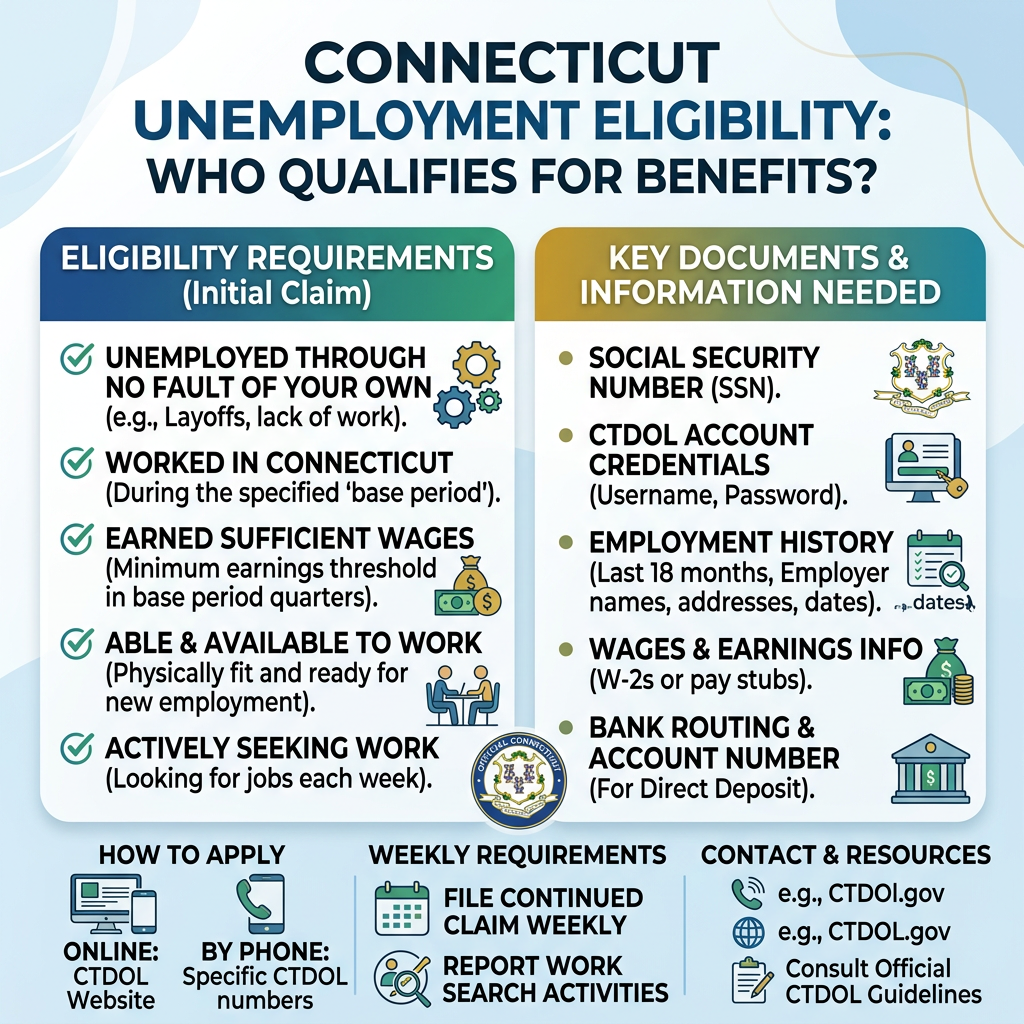
To qualify for unemployment benefits in Connecticut, you generally must meet several requirements. CTDOL states that eligible claimants generally must:
- Be physically and mentally able to work
- Be totally or partially unemployed
- Have an appropriate reason for being unemployed
- Have sufficient qualifying wages
- Have worked in Connecticut during the applicable period, subject to the rules that apply to the claim
- Actively seek work
- File the claim on time
- Remain available for suitable work
These requirements are considered together. Meeting one requirement does not automatically guarantee eligibility.
Who Can Qualify for Unemployment in Connecticut?
Many people who lose work through no fault of their own may qualify for unemployment benefits.
For example, you may potentially qualify if:
- Your employer laid you off because there was not enough work
- Your employer reduced your hours
- Your employer reduced its workforce
- You became partially unemployed
- You left a job for a qualifying work-related reason
- You meet the applicable wage and availability requirements
However, every claim is reviewed based on its individual circumstances. CTDOL specifically notes that the reason you are no longer working is an important part of the eligibility determination.
Do You Have to Be Laid Off to Get Unemployment in Connecticut?
No.
A layoff is one common reason someone may qualify, but it is not the only possible situation.
For example, CTDOL states that a person who voluntarily leaves employment may potentially qualify when the separation was for good cause connected with the job.
On the other hand, voluntarily leaving employment for a personal reason unrelated to the job may result in disqualification.
This distinction is important because the circumstances surrounding your separation can affect your eligibility.
Can You Get Unemployment If You Quit Your Job?
Possibly.
Quitting your job does not automatically mean you can never receive Connecticut unemployment benefits. CTDOL examines the reason for the voluntary separation. A claimant may qualify when the circumstances meet Connecticut’s requirements for good cause related to the employment.
For example, CTDOL lists certain work-related circumstances, such as unsafe working conditions, as examples that may support eligibility.
However, quitting simply because you wanted to leave the job for a personal reason may not satisfy the eligibility requirements.
If you quit, be prepared to explain accurately why you left and provide supporting information if CTDOL requests it.
Can You Get Unemployment If You Were Fired?
Being fired does not automatically determine the outcome of an unemployment claim. CTDOL reviews the circumstances surrounding the separation.
For example, CTDOL states that a claimant may be disqualified when they were fired for misconduct.
If you were discharged, CTDOL may need information from both you and your former employer before making an eligibility determination.
This can result in a fact-finding process.
Can You Get Unemployment If Your Hours Were Reduced?
Yes, reduced hours can potentially qualify for unemployment benefits.
CTDOL identifies workers whose hours were reduced because their employer did not have enough work as an example of a situation that may qualify.
However, you still need to meet the other requirements for the weeks you claim benefits.
If you work while receiving unemployment, you must accurately report your earnings when filing your weekly certification.
CTDOL requires claimants to report gross wages, rather than take-home or net pay.
Do You Need Enough Wages to Qualify?
Yes.
Connecticut unemployment eligibility includes a monetary requirement.
CTDOL reviews wages earned during the applicable base period to determine whether you have sufficient wage credits to qualify. The department’s current benefits guide explains that it looks at wages earned during the relevant period before the claim is filed.
For 2026, Connecticut’s minimum base-period earnings requirement is $1,760.
This monetary requirement is separate from other eligibility conditions, such as the reason you became unemployed and whether you are available for work.
Why Your Recent Paycheck Does Not Tell the Whole Story: Your current hourly wage or most recent paycheck does not by itself determine whether you qualify.
CTDOL uses wages from the applicable base period.
For most claims, the standard base period consists of the first four of the last five completed calendar quarters before the benefit year begins. If you do not qualify using the standard base period, an alternate base period may apply under the applicable rules.
This is also why the Connecticut unemployment benefit amount may be different from what you initially expect.
Do You Have to Be Available for Work?
Yes.
To receive benefits for a week you claim, you generally must be able and available to work. CTDOL states that claimants generally must be:
- Physically and mentally able to work
- Available for work
- Making reasonable efforts to obtain work
- Ready, willing, and able to accept suitable work
This requirement applies to your ability and availability during the weeks for which you are requesting benefits.
What Does “Available for Work” Mean?
Being available for work generally means that you are prepared and able to accept suitable employment if an appropriate opportunity becomes available.
A personal situation that prevents you from accepting work can affect eligibility.
For example, if you are unavailable because of a personal obligation that prevents you from working, that may raise an eligibility issue.
CTDOL’s availability guidance also explains that full-time work is generally considered 35 hours or more per week, depending on the industry.
Availability requirements can be fact-specific, so do not assume that simply being registered as unemployed is enough.
Do You Have to Search for Work?
Generally, yes.
Connecticut requires claimants receiving unemployment benefits to search for work each week unless CTDOL has approved an applicable exemption.
Current CTDOL guidance requires at least three work-search activities each week, including at least one employer contact.
Examples of qualifying activities can include:
- Contacting an employer about full-time work
- Attending a job interview
- Attending an American Job Center workshop
- Attending a job fair
- Participating in reemployment services
- Creating and uploading a résumé to CTHires
- Creating a professional networking profile
Your work-search activities must be reported when you complete your weekly claim. For more details, see our guide to Connecticut unemployment work-search requirements.
Are There Exceptions to the Work-Search Requirement?
Yes.
CTDOL lists several situations in which a claimant may not have to complete the normal work-search requirement.
Examples include:
- You expect to return to your previous employer within 13 weeks
- You are a trade union member and required to seek work through the union hall
- You are participating in an approved Shared Work program
- You are on jury duty
- You have a new job scheduled to begin within 13 weeks
- You are participating in CTDOL-approved training
The applicable exemption and documentation requirements can vary by situation.
Do not assume that you are exempt simply because one of these situations appears similar to yours. Follow the instructions associated with your claim or contact CTDOL when clarification is needed.
Can You Get Unemployment If You Work Part-Time?
Potentially.
Connecticut allows eligible workers to receive partial unemployment benefits in certain circumstances. However, working part-time does not eliminate your reporting responsibilities.
You must report your earnings accurately when completing your weekly certification. CTDOL specifically states that claimants must report gross wages.
You may also still have to search for full-time work.
CTDOL’s work-search guidance states that people receiving partial unemployment benefits must generally continue searching for full-time work unless an applicable exemption has been approved.
Our separate Connecticut unemployment part-time work guide can cover the earnings and partial-benefit calculation in greater detail.
Can You Get Unemployment If You Cannot Work Full-Time?
In general, Connecticut unemployment requires you to be able and available for full-time employment.
There is an exception for certain individuals who cannot work full-time because of a permanent, long-term, or chronic physical or mental impairment and can provide appropriate documentation from a licensed physician.
CTDOL may conduct a fact-finding process to determine eligibility in these circumstances.
This is different from simply preferring part-time work.
Do You Have to Be Legally Authorized to Work?
Yes.
CTDOL states that claimants must be legally authorized to work in the United States.
For non-U.S. citizens, the department may require proof of appropriate immigration or employment authorization status when processing a claim.
Providing inaccurate information about work authorization can affect your claim.
Can Self-Employed People Receive Connecticut Unemployment?
Self-employment can create different eligibility issues.
CTDOL identifies full-time self-employment as a situation that may prevent a person from receiving regular unemployment benefits.
If you operate a business while claiming unemployment, you should report applicable income and business activity accurately.
CTDOL’s ReEmployCT FAQ also instructs claimants to report profits from a small business in addition to their main occupation when applicable.
Do not assume that operating a small side business automatically makes you ineligible. Your individual circumstances matter.
Can You Get Unemployment If You Receive Workers’ Compensation?
Certain workers’ compensation situations can affect unemployment eligibility.
CTDOL identifies receiving total workers’ compensation for an on-the-job injury as one circumstance that may prevent a claimant from receiving regular unemployment benefits.
Workers’ compensation and unemployment benefits involve different programs and eligibility rules.
If you are receiving workers’ compensation and have also become unemployed, provide accurate information when filing and respond to any CTDOL requests for additional information.
Can Teachers and Educational Employees Receive Unemployment?
Educational employees can have special unemployment rules.
CTDOL lists certain educational employees who have reasonable assurance of returning to work among situations that may prevent payment of unemployment benefits.
The exact circumstances matter, so school employees should review the applicable CTDOL guidance rather than assuming that summer or school-break unemployment automatically qualifies.
What If You Are a Professional Athlete?
Professional athletes can also be subject to special eligibility rules.
CTDOL identifies professional athletes with reasonable assurance of returning to work as circumstances that may prevent unemployment benefits.
Because these cases can involve specialized employment arrangements, the individual facts of the claim are important.
What Types of Employment May Not Be Covered?
Most workers are covered by unemployment insurance, but Connecticut identifies certain categories of employment that may not be covered under the state’s unemployment system.
Examples identified by CTDOL include certain:
- Newspaper carriers under age 18
- Commission-only real estate agents
- Sole proprietors and partners
- Certain family employment
- Certain religious or church-related employment
- Railroad workers
- Certain elected officials
- Certain government employees
- Other specifically excluded categories
This does not mean every person working in one of these broad categories is automatically excluded. The exact employment arrangement and applicable law matter.
Do You Have to Live in Connecticut to Get Connecticut Unemployment?
Not necessarily.
Unemployment insurance is generally connected to where you worked and where your wages were reported, rather than simply where you currently live.
CTDOL’s eligibility guidance states that one of the general requirements is having worked in Connecticut during the applicable period, although the relevant period can be longer in some circumstances.
If you recently moved out of Connecticut after working there, you should still review whether Connecticut is the appropriate state for your claim.
Claims involving work in multiple states can require additional information and may take longer to process.
When Should You File for Connecticut Unemployment?
If you believe you may qualify, CTDOL advises filing immediately rather than waiting for an official termination notice.
Retroactive payments are generally not automatically available for weeks before you filed, so delaying a claim can create problems.
You can start the process through ReEmployCT.
All unemployment filers must create a ReEmployCT account, and the system is available 24/7 except during maintenance.
Does Filing for Unemployment Mean You Are Automatically Approved?
No.
Filing a claim and being eligible for benefits are two different things.
After you file, CTDOL reviews the information provided and determines whether you meet the applicable requirements.
Some claims can involve a fact-finding process before a determination is made. CTDOL may request additional information from you, your former employer, or other sources.
Responding to requests promptly is important.
What Happens If CTDOL Questions Your Eligibility?
If an eligibility issue arises, CTDOL may contact you for additional information. For example, questions may involve:
- Why you left your job
- Why your employer terminated you
- Whether you were available for work
- Whether you were able to work
- Your reported wages
- Your work-search activities
- Whether you refused suitable work
- Whether you had another source of income
Provide accurate information and respond by the deadline given in the notice. Do not ignore an eligibility questionnaire or fact-finding request.
What Is RESEA and Can It Affect Eligibility?
Some unemployment claimants are selected for the Reemployment Services and Eligibility Assessment (RESEA) program.
The program is designed to provide reemployment assistance and assess eligibility-related requirements.
Current CTDOL guidance states that claimants selected for RESEA must attend a mandatory virtual meeting to continue receiving unemployment benefits. Failure to attend may result in disqualification.
If you receive a RESEA notice in your ReEmployCT account, follow the instructions and attend the required meeting.
What Can Cause You to Lose Eligibility for a Week?
Even if you initially qualify for unemployment, you must continue meeting the requirements for each week you claim benefits.
Potential issues can include:
- Not being able or available for work
- Failing to meet work-search requirements
- Failing to complete the weekly certification
- Failing to report wages
- Refusing suitable work
- Failing to respond to CTDOL requests
- Providing inaccurate information
- Starting full-time employment
- Other circumstances that affect weekly eligibility
Eligibility can therefore change after a claim has already been approved.
What Should You Have Before Filing?
Having the necessary information ready can make the application process easier. Depending on your circumstances, you may need information about:
- Your identity
- Your employment history
- Your employers
- Dates of employment
- Wages
- The reason you became unemployed
- Your availability for work
- Your work authorization
- Dependents, if applicable
- Banking or payment information
- Other income or employment
Make sure the information you provide is accurate.
Small errors can cause delays or require additional review.
Connecticut Unemployment Eligibility Checklist
Before filing, consider whether the following generally apply to you:
- You are unemployed or partially unemployed
- You have sufficient qualifying wages
- You have an eligible reason for your unemployment
- You are physically and mentally able to work
- You are available for suitable work
- You are legally authorized to work
- You are prepared to search for work unless an exemption applies
- You can accurately report your wages and other required information
- You can complete your weekly certifications
- You can respond to CTDOL requests for information
This checklist is only a general guide. It is not an official eligibility determination.
Connecticut Unemployment Eligibility vs. Benefit Amount
Eligibility and benefit amount are related but different questions.
Eligibility asks:
“Do I qualify to receive unemployment benefits?”
Benefit amount asks:
“If I qualify, how much could I receive?”
Your eligibility depends on factors such as wages, separation from employment, ability and availability to work, and ongoing requirements.
Your benefit amount is calculated separately based largely on qualifying wages.
For more information about the amount you may receive, see our Connecticut Unemployment Benefit Amount guide.
Frequently Asked Questions
What are the basic requirements for Connecticut unemployment?
Generally, you must be unemployed or partially unemployed, have sufficient qualifying wages, have an eligible reason for your unemployment, be able and available for work, actively seek work when required, and meet the applicable filing requirements.
Can I get unemployment if I was laid off?
A layoff because your employer does not have enough work is one of the situations that may qualify for unemployment benefits, provided you meet the other requirements.
Can I get unemployment if I quit?
Possibly. Connecticut considers the reason for quitting. A voluntary separation may qualify when it meets the state’s requirements for good cause connected with the employment.
Can I get unemployment if I was fired?
Possibly. Being fired does not automatically determine eligibility. However, a discharge for misconduct can result in disqualification.
Do I have to look for a job every week?
Generally, yes. Connecticut requires at least three work-search activities each week, including at least one employer contact, unless an approved exemption applies.
Can I work part-time and collect unemployment?
You may be able to receive partial unemployment benefits while working part-time if you remain otherwise eligible. You must report your gross earnings accurately and generally continue looking for full-time work.
Do I need to live in Connecticut to qualify?
Not necessarily. Connecticut unemployment eligibility is connected to qualifying employment and wages, so someone who worked in Connecticut may have a claim even if they subsequently live elsewhere.
Does filing a claim guarantee that I will receive benefits?
No. Filing starts the claim process. CTDOL determines eligibility based on your circumstances and applicable requirements. Some claims require additional fact-finding before a decision is made.
How long can I receive Connecticut unemployment?
Regular unemployment benefits are generally available for up to 26 weeks, provided you remain eligible and have sufficient benefits available on your claim.
Where do I file for Connecticut unemployment?
New unemployment claims are filed through Connecticut’s ReEmployCT login page. All filers must create a ReEmployCT account.
This is an independent informational guide and is not affiliated with, operated by, sponsored by, or endorsed by the Connecticut Department of Labor or the State of Connecticut. Unemployment rules can change, and individual eligibility depends on the facts of each claim. Verify important requirements with CTDOL before relying on this information.